Cigar Tunneling — Why It Happens and How to Fix It
Tunneling is what happens when the filler burns ahead of the wrapper, leaving a hollow core and a rim of unburnt leaf. This guide covers what causes it, how to tell it apart from canoeing and plain uneven burn, and the corrective steps that actually work mid-smoke.
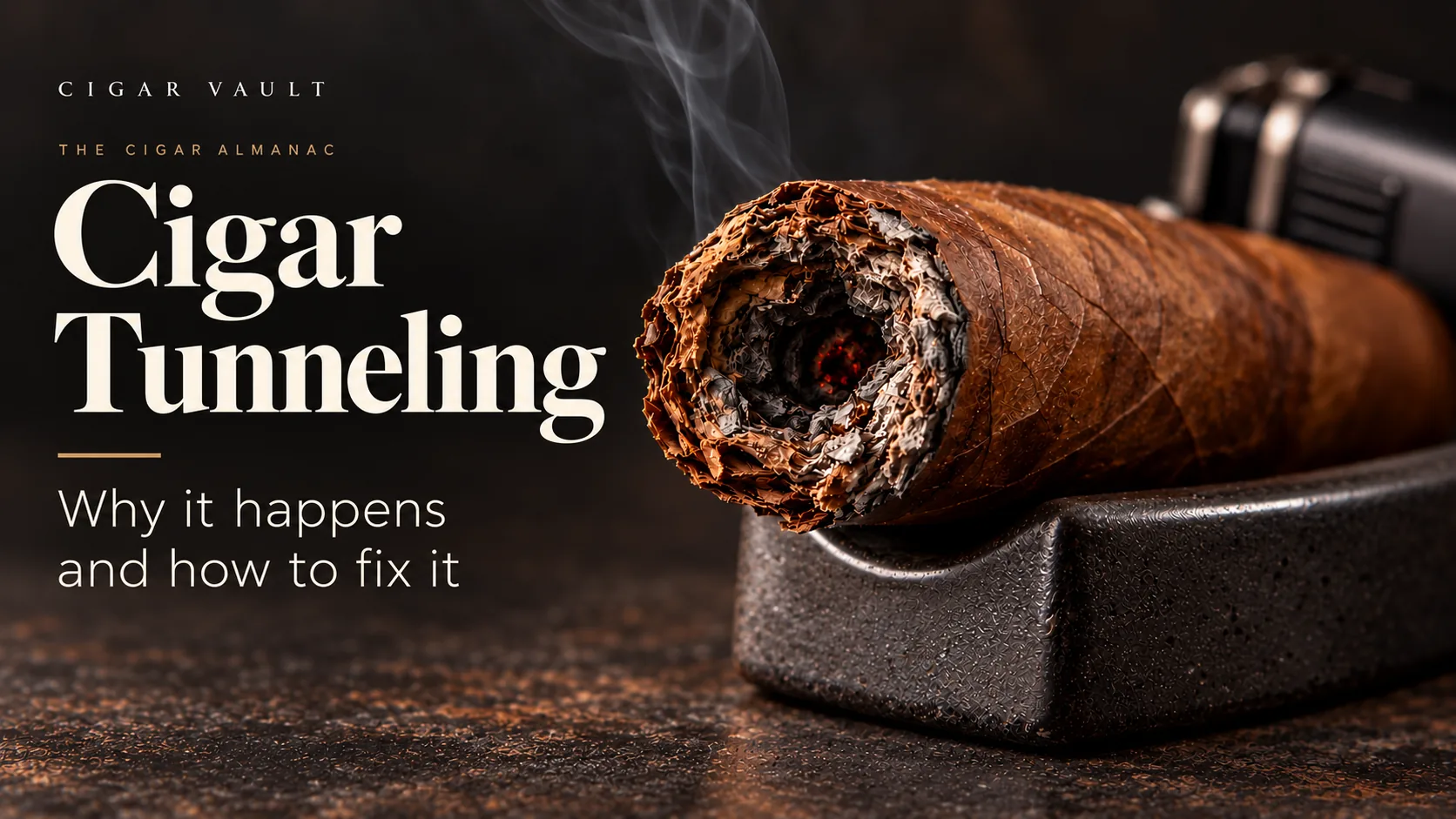
You tap the ash off and find a crater instead of a flat face — the filler has burned back into the cigar like a lit fuse, while the wrapper and binder sit around it as an unburnt collar. That's tunneling, and it's one of the more common ways a good cigar turns into a chore halfway through.
The fix usually isn't complicated. Understanding why it started matters more, because the same cause will keep reappearing if the cigar is stored or lit the same way next time.
What tunneling actually is
A cigar burns properly when the wrapper, binder, and filler consume at roughly the same rate, producing a flat or gently rounded burn line that advances evenly down the stick. Tunneling breaks that balance in one direction: the filler races ahead, and the outer leaves lag behind.
It's worth separating this from its cousins. Canoeing is when one side of the cigar burns faster than the other, so the burn line runs diagonally and the cigar takes on the profile of a canoe hull. Uneven burn is a milder version of the same thing and often corrects itself. Tunneling is specifically a depth problem rather than a side-to-side problem — the core is gone and the shell remains.
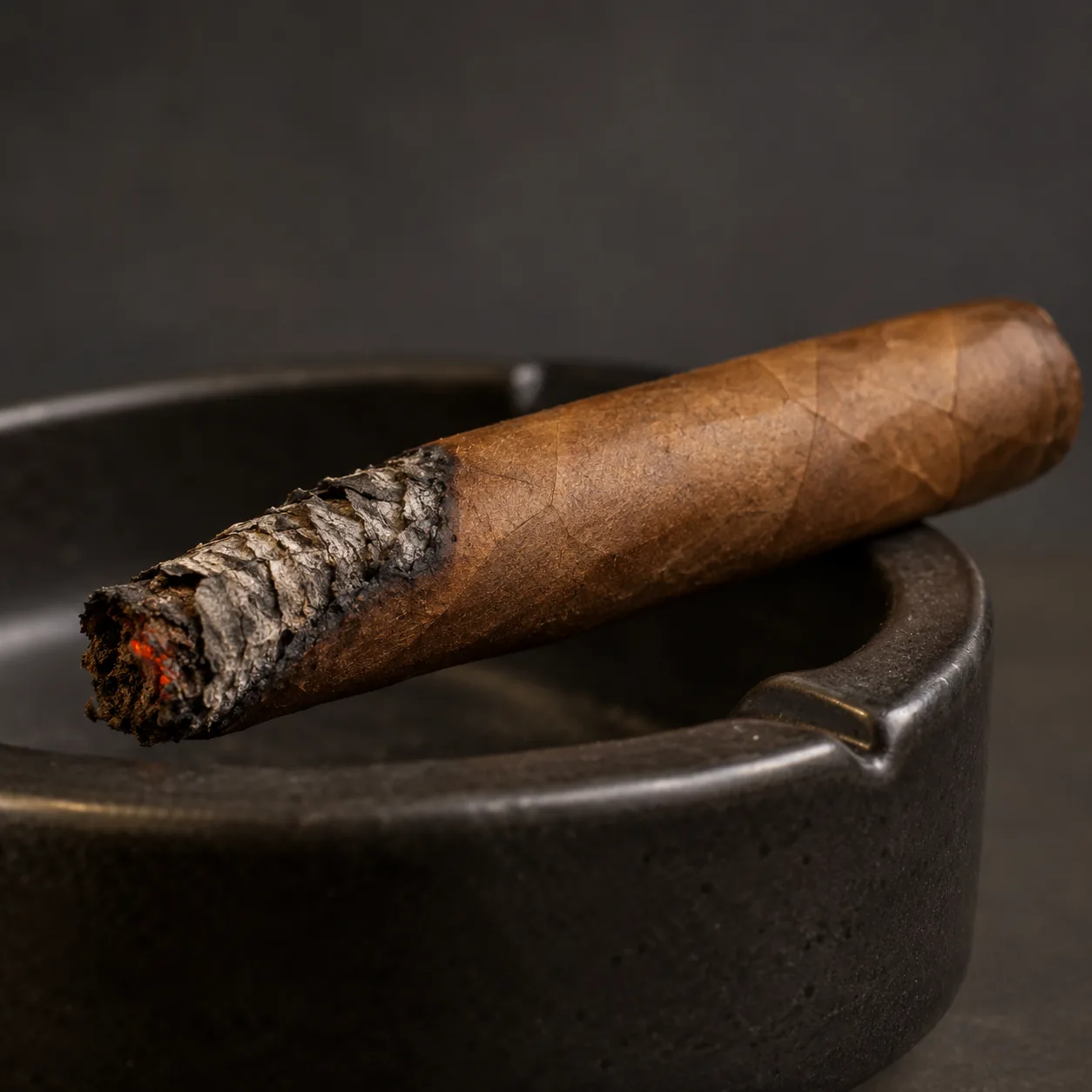
The practical consequence is heat. With the ember buried inside the cigar, it sits closer to the smoke path and gets less air circulating around it. Smoke tends to come through hotter and harsher, and the wrapper flavors — which is where a lot of the character lives — are no longer contributing.
Why it happens
Moisture imbalance
The most common cause is a wrapper that holds more moisture than the filler underneath it. Wrapper leaf is thin and sits on the outside, so it takes on ambient humidity faster than the bunched filler at the core. A cigar that has been sitting in a humid environment, or one that was moved from dry storage into wet storage recently, can end up with a damp shell around a comparatively dry centre. Damp leaf resists burning; dry leaf doesn't. The result is exactly the burn pattern described above.
The reverse situation — a dry wrapper over damp filler — tends to produce different problems, including a wrapper that burns ahead and unravels.
An incomplete light
If the initial toast only catches the centre of the foot, the cigar starts tunneling from the first puff and never really recovers. This happens easily when the flame is applied straight into the middle of the foot rather than being worked around the perimeter, or when a lighter is held too close and the flame concentrates on one point.
Draw and construction
A cigar with a loose or hollow core in one section can channel air straight up the middle. Bunching is hand work, and even careful rollers produce the occasional stick with a soft spot. Hard drawing on a cigar that's already burning unevenly makes it worse, because the extra airflow feeds the part of the ember that's already ahead.
Smoking rhythm
Puffing frequently pulls hot air through the core and accelerates the interior burn. Letting a cigar sit too long between puffs is the opposite problem — the ember shrinks toward the centre where it's most sheltered, and when you draw again, that small central ember is what relights.
Fixing it mid-smoke
The goal is to bring the outer leaves back level with the core, then keep them there.
Touch up the wrapper, not the core. Take a soft flame and play it around the unburnt rim of wrapper and binder, keeping it off the recessed centre. You're trying to catch the leaves that are lagging, and adding more fire to the part that's already ahead defeats the purpose. Rotating the cigar as you go helps you work evenly around the circumference.
Blow gently through the cigar first. A light puff outward clears stale smoke and can reveal exactly where the burn line sits, which is otherwise hard to judge through the ash.
Knock off the ash before touching up. Ash sitting over the unburnt rim will shield it from the flame and make you think the touch-up failed when it simply never reached the leaf.
Slow down afterward. Once the burn is level, give it a little time and puff at a relaxed pace. Immediately drawing hard on a freshly corrected cigar tends to reopen the same tunnel.
If the tunnel is deep and the wrapper has already receded badly, some smokers trim the affected section back with a cutter to expose a fresh, even face and relight from there. It costs you part of the cigar but can rescue the rest. Whether this is worth doing, or whether a badly tunneled cigar is better set aside, is a matter smokers genuinely disagree on.
Preventing it next time
Toast the foot properly. Hold the flame slightly away from the leaf and rotate the cigar so the entire perimeter of the foot glows before you take the first draw. A visible, even ring of ember at the outside edge is the thing to look for — if the centre is lit and the rim isn't, you have already started a tunnel.
Give the cigar a look before lighting. Rolling it lightly between your fingers tells you a fair amount about the bunch. Soft spots, hard plugs, and marked variation in firmness along the length all correlate with burn problems.
Pay attention to storage. Sudden moves between environments of very different humidity set up the wrapper-versus-filler imbalance that drives tunneling. Cigars that have rested in stable conditions for a while tend to burn more predictably than ones that were recently relocated. If a cigar feels damp on the outside, letting it sit in a drier environment for a period usually helps more than trying to fight the burn with a lighter.
And smoke at a steady pace. Most burn issues are aggravated by extremes in either direction — hammering the cigar or neglecting it. A comfortable, unhurried rhythm keeps the ember broad and shallow, which is the shape you want.
When it isn't your fault
Some cigars tunnel because of how they were bunched, and no amount of careful lighting will change that. Hand-rolled products vary, and the occasional stick has an internal channel or a section of filler packed loosely enough that air prefers it. Correct what you can, accept what you can't, and note that a pattern across several cigars from the same box points at the cigars, while a one-off points at the light or the storage.